

I couldn't believe my luck when I unexpectedly encountered Ghalib himself. It was a moment filled with disbelief and awe, making me question whether it was truly the same Ghalib I had come to know through his timeless works. The thought of asking for his autograph on my cherished copy of Diwan-e-Ghalib crossed my mind, but I quickly realized the impracticality of such a request to a poet from the 19th century. I wondered if anyone in this modern era had ever approached him with a similar plea, and if so, how awkwardly they must have felt.
Ghalib introduced himself in the same witty and clever manner I had read about in books, further intensifying my admiration for him. Countless questions raced through my mind, eager to be voiced in his presence. Yet, in typical fashion, I found myself offering only a simple "Acha" (okay) in response. I couldn't help but wonder why I reacted that way, as my ambivert nature tends to lean towards introversion in such extraordinary circumstances.
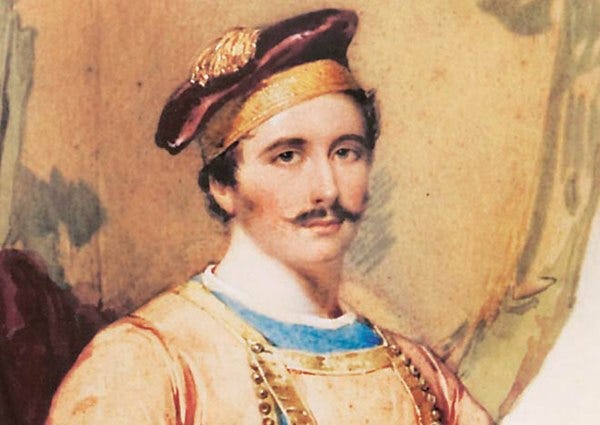
Continuing my stroll through the narrow lanes, I couldn't help but notice that everything seemed transformed, presenting a Delhi unlike any I had grown accustomed to. The city appeared as if it had transcended time, embracing a fusion of past and present. Suddenly, a figure caught my attention—a white man, but not an ordinary one. He appeared as if he had stepped out of a costume show or emerged from the world of theater. Clothed in traditional Mughal attire, he wore a Kamar bandh, a turban adorning his head, a long kurta, and Hindustani pajamas. A staff accompanied him, held by a man who fanned him with a majestic peacock feather fan. It was as if an Eastern prince had descended upon the lanes of Delhi.
Recognizing the familiar face, I recalled him as William Fraser, though momentarily entertaining the thought that he could be David Ochterlony. However, upon closer reflection, it became evident that he was indeed William Fraser.