


Disclaimer: The views, folk traditions, and family histories expressed in these submissions are those of the individual contributors.
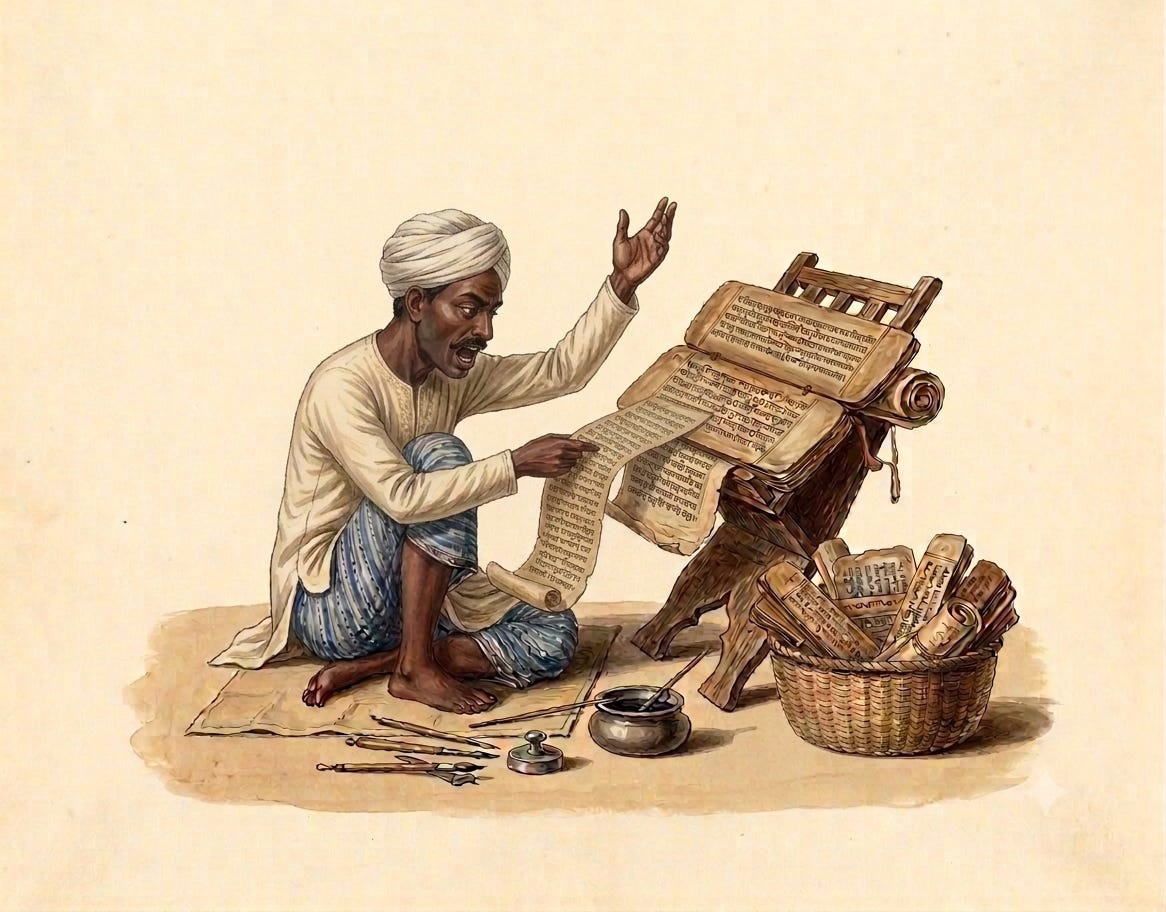
The great Albanian writer Ismail Kadare wrote in his famous book Broken April that
"what was printed in books was only the corpse of what was recounted orally."
This captures the unique vitality of the spoken word, a power deeply embedded in India's rich tradition of oral storytelling and folklore, where stories lived vibrantly in the hearts of villagers long before they were ever committed to paper.
When we asked our community to share the forgotten stories, oral histories, and family legends that have shaped them, we received a collective map of memory. This week’s digest is dedicated to those living archives: the stories that survive because someone chose to tell them, and someone chose to remember.
The Anatomy of a Knot: Braids, Taboos, and Bengali Women
By Anuska Roy


In the quiet landscape of a Bengali home, hair is never merely an aesthetic ornament; it is a sacred, living archive. It is an emotional landscape woven through generations—brushed with fragrant coconut oil, dried in the gentle warmth of the afternoon sun, and braided into tight, protective plaits before nightfall. Growing up, our relationship with our hair was guided by a silent, complex language of rules. We were warned never to leave it loose after dusk, never to cut it short, and to treat its containment as a measure of our character.
To look closely at these rules is to understand that in our folklore, a woman’s hair is viewed as a spiritual antenna—a conduit of immense personal power, sexuality, and cosmic order. By tracing the folk beliefs surrounding the bound plait, the forbidden night, and the forced severance of the widow’s locks, we uncover how folklore has long used hair as a canvas to negotiate the boundaries of female autonomy.
The Nocturnal Untethering: Why We Braid Before Bed
There is a distinct chill in the folk warnings handed down by maternal ancestors: never sleep with your hair open at night.
In the grammar of Bengali delta gothic, the night is when the veil between our structured world and the supernatural thins. Loose hair is believed to be highly receptive to wandering energies. Folklore warns that untied, flowing hair is an open invitation to jinns, restless spirits, or the Boba (the sleep-paralysis entity) that roam after sunset. It is viewed as a “leaky” aura—an unknotted circuit through which a woman’s vital energy (Prana) can easily be sapped or manipulated by the unseen.
But there is a psychological mirror to this superstition. A woman with her long hair unkempt, wild, and flowing in the dark physicalizes the terrifying imagery of our regional spirits—the Petni or the Chudail. By forcing young girls to bind their hair into a neat beni (plait) before closing their eyes, domestic space enforces a physical boundary. To tie the hair is to civilize the self; to leave it open is to invite the untamed chaos of the night.
The Weight of Length: Cosmic Order vs. Wild Freedom
The expectation for women to grow their hair long, rather than short, is deeply rooted in the delicate balance between Sattva (order) and Tamas (chaos) within Hindu iconographical lore.
In our cultural consciousness, the long, beautifully bound tresses of Goddesses like Lakshmi and Parvati signify domestic prosperity, maternal nurturing, and societal harmony. Their immense spiritual and life-giving power is disciplined, gathered, and dedicated to the welfare of the household.
Conversely, Goddess Kali is depicted with her long hair completely wild, unkempt, and flying free. Her unbound hair represents absolute, untamed liberation—a force that has shattered all societal constraints and chosen the path of raw, unchecked destruction.
By demanding that a woman keep her hair long but strictly bound, folklore subtly reinforces the societal ideal: a woman must possess life-giving vitality, but she must keep it firmly under lock and key. The modern-day domestic anxiety surrounding a woman choosing a “boy-cut” or a short bob is simply the legacy of this fear. In the traditional imagination, a woman who willingly cuts her hair short is refusing to perform the aesthetics of docility. She is stepping out of the cosmic order.
The Severed Thread: Hair and the Rituals of Widowhood
Nowhere is the connection between female hair and patriarchal ownership more starkly felt than in the historic, tragic rituals of widowhood.
In orthodox traditions, a woman’s long, lustrous hair was historically considered part of her Saubhagya—her marital good fortune. Her grooming, her vermilion, and her long tresses were grown and preserved for the life and pleasure of her husband. Consequently, when a husband passed away, many communities forced the widow to shave her head entirely.
This act of tonsure was a brutal, symbolic desexualization. By shaving her head, the community stripped her of her beauty, her fertility, and her active place in the auspicious social world. A shaved head announced her transition into a living shadow—an ascetic who no longer belonged to the world of desire.
Because short or shaved hair was historically associated with the profound grief and isolation of widowhood, keeping hair long became a fiercely guarded symbol of life, marriage, and active womanhood.
Reclaiming the Wild Tresses
To understand these folk traditions is not to discard them, but to reclaim their poetic power. When we look at the Petni sitting in the branches of the Sheora tree with her hair flowing wild, she is no longer just a figure of terror. She is a woman who has stepped entirely outside the boundaries of domestic containment. Her open hair is her flag of independence.
When we choose how to wear our hair today—whether we let it run wild in the night breeze, cut it short in defiance of old expectations, or braid it on our own terms—we are engaging in a quiet, ancestral conversation. We are deciding exactly how much of our wild, deltaic power we wish to keep, and how much we are ready to set free.
Mudian ka Kuwan: The Bundeli Legend Behind an Unlikely Name
By Amogh Mishra
A surname is usually the least interesting thing about a family, until someone tells you the story behind it. A decade ago, I was sitting with my maternal grandfather when he told me a story about my grandmother's family. The story was a piece of folklore which had been passed down from generation to generation in casual conversations like this one.
The folklore was about the unusual surname that runs in my maternal grandmother’s family. They are Brahmins who were once known as “Dwivedi” but have used the surname “Mudia” for generations. The term “Mudia” is derived from the Bundeli word Mudi, which means “Head”.
Battles are often remembered through the victories of kings. Families remember them differently. According to family tradition, one of our ancestors fought under Maharaja Chhatrasaal Bundela during his conflicts with Aurangzeb’s forces, amid growing anger over measures such as the reimposition of the Jizya, my family’s oral tradition places him among those who did not return. The story says he beheaded several Mughal soldiers and threw their heads into a well. It further tells that, during the battle, he himself was struck on the head by a vertical blow that split his head down the middle. He tied the wound together with a cloth and continued fighting.
Family memory lingers on that moment rather than the battle itself. It remembers neither the number of men who fought nor the ground on which they stood. Even the time period of the battle is obscure. It remembers only the sight of a man binding together what had been split apart, refusing to abandon the field. Our family tradition holds that it was after this act that he was bestowed the Upadhi ‘Mudia’, a name that the coming generations would eventually inherit as their surname.
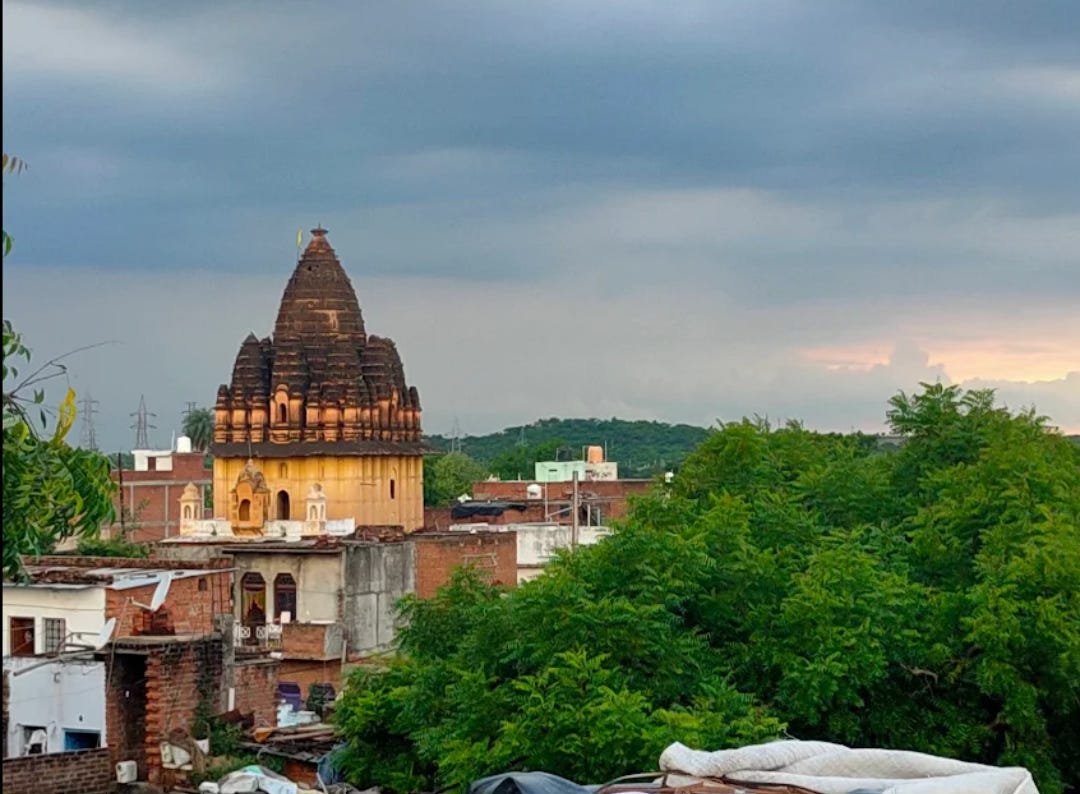
The family also points to a place called “Mudian ka Kuwan” (Well of Heads) in Datia, Madhya Pradesh, where the family still resides. Hidden in the city’s narrow lanes, the site remains a familiar local landmark. A temple known as Mudian Kuwan Mandir stands there today, alongside an old well from which the locality derives its name. My mother’s maternal family has been living in its immediate vicinity for generations now.
My mother also claims to have heard this story from her grandparents. The surname “Mudia” has existed in the family for generations, and it is not just our family but a few others as well who bear this surname. The tale fits remarkably well within the historical backdrop of its time. Maharaja Chhatrasaal ruled Bundelkhand, fought against Aurangzeb’s forces, and Brahmins are known to have served in his army. But there are no official records to support this story. All that exists is an oral tradition that has been passed down and retold so many times that its form itself can be questioned. Some details may have been forgotten, while others may have exaggerated with each retelling.
Perhaps none of it happened. Perhaps every detail has changed over centuries of retelling. Yet the surname “Mudia” survives to this day and “Mudian ka Kuwan” continues to exist in local memory. Perhaps this story belongs neither to history nor to myth, but to that fragile space in between where memory lives. And like memory itself, it will endure only as long as there is someone left to remember, and someone willing to tell it again.
Boho Haat is an initiative by Bohemian Dialogue to celebrate the oral storytelling traditions, artistic memories, and disappearing textures of the Indian subcontinent. Bring a piece of this legacy home—explore our tote bags.

