

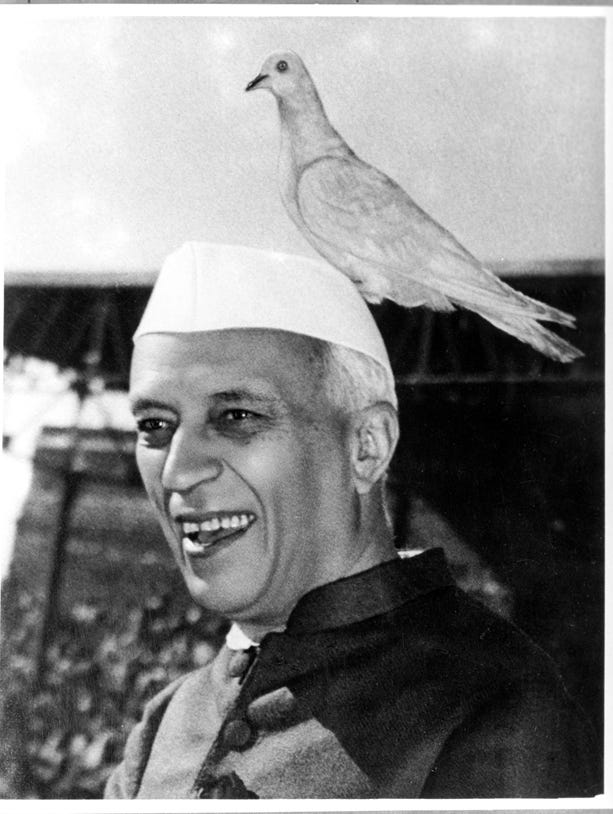
It has become something of a fashion to dismiss Nehru. Yet I suspect that very few who do so have read, or will ever read, The Discovery of India. Having read it myself, I can say it is a phenomenal piece of writing. Jawaharlal Nehru wrote the book while imprisoned in Ahmednagar Fort, working with only the limited resources available to him in jail. Knowing this makes the experience of reading it even more remarkable. I read the book very recently. However, I had watched the television series Bharat Ek Khoj by Shyam Benegal long ago, which is based on it. Even then, some parts felt extraordinary.
In the first 68 pages, Nehru tells us why he is telling the story of India. When someone takes 68 pages to explain the why, it shows how important it is for him to define his position on India, both for himself and for the world. Nehru wrote:
What is my inheritance? To what am I an heir? To all that humanity has achieved during tens of thousands of years, to all that it has thought and felt and suffered and taken pleasure in, to its cries of triumph and its bitter agony of defeat, to that astonishing adventure of man which began so long ago and yet continues to beckon to us. ..
The book is full of such prose, the kind that makes him a great writer. But what led me to write this newsletter is this question: why did he choose to write this book? Was it pure love for the country, or a way to assert his position before the British, or simply the urge to write? Honestly, after reading it, it is difficult to believe there is no attachment to this country, that it is merely an opportunistic act.
This question is also deeply personal to me because, in my own attempt to tell the story of India, I often ask the same thing. Telling the story of India can become a refuge when you are tired of the West and the many heavy and weird things it carries. Or perhaps it comes from feeling that I know this story too well. In either case, there is something very special about this country, and its story always feels worth telling. Nehru continues:
But there is a special heritage for those of us of India, not an exclusive one, for none is exclusive and all are common to the race of man, one more specially applicable to us, something that is in our flesh and blood and bones, that has gone to make us what we are and what we are likely to be.
The choice of title of the book is also striking. It is not The Story of India but The Discovery of India, as if one must look at one’s own homeland through a fresh, almost foreign lens. In my own weekend journeys, when my day job demands that I look West, I find something similar happening. When I visit a fort or a forgotten corner of Delhi that I have never seen before, I feel like an outsider. I feel that I am discovering India too. Nehru wrote in Discovery of India.
Mohandas Karamchand Gandhi’s An Autobiography: The Story Of My Experiments With Truth and Hind Swaraj, Rabindranath Tagore’s Nationalism and Gora, and Jawaharlal’s Nehru’s An Autobiography—is The Discovery of India
In those opening 68 pages, there is also a chapter on Kamla Nehru, his wife, her deteriorating health, and her death. Amid all his reflections, I find this part especially human. Nehru’s thoughts on this imperfect relationship reach toward what he calls the fundamental problem of human relationships, something often ignored in our arguments about politics . Grief and loss can be powerful motivators, and in those moments, we often feel the urge to create something that endures.
The problem of human relationships, how fundamental it is, and how often ignored in our fierce arguments about politics and economics. It was not so ignored in the old and wise civilizations of India and China, where they developed patterns of social behaviour which, with all their faults, certainly gave poise to the individual.
I have always found an urge to create or build a new project as a way to deal with my own struggles. This may sound cliche, but it feels true to me. Mohsin Hamid, the Pakistani writer, captures this feeling well when he says:
We are all refugees from our childhoods. And so we turn, among other things, to stories. To write a story, to read a story, is to be a refugee from the state of refugees. Writers and readers seek a solution to the problem that time passes, that those who have gone are gone and those who will go, which is to say every one of us, will go. For there was a moment when anything was possible. And there will be a moment when nothing is possible. But in between we can create.
The purpose of this newsletter is to engage with Nehru’s mind, yet I feel he is far too complex to fully comprehend. Forget Nehru, I do not even have a clear answer for why I do what I do. Perhaps it is enough to follow Mohsin Hamid’s suggestion and focus on creating. I plan to pick a few stories from The Discovery of India and attempt my own small acts of discovery in the next part.
🙌